
In short
82.3% of coaching websites hide their prices, but 65% of the sites that did best show one. How to make either choice work, and what to write if you don't.
82.3% of coaching websites don't show a price anywhere. The sites that did best in my report show a price 65% of the time. Here's why hiding your price can cost you, and what you can write if you don't feel right putting your prices on your site.
I'll be honest, this is one of the subjects that winds me up a bit. Coaches get told two completely different things about it, and both come from people who sound very sure of themselves. One lot says never put your prices up: get them on a call, build the relationship, and talk money once they can see the value. The other lot says put everything up, be transparent, people respect it. And you're stuck in the middle wondering who to believe.
So rather than add a third opinion, we counted. We looked at 10,954 live coaching websites and checked each homepage for 10 things a stranger needs before they'll get in touch. Things like whether you can tell who it's for, whether there's any proof it works, and whether there's a price. If you want to know exactly how we checked them, it's all here, but you don't need it to follow this.
Should you put your prices on your coaching website?
In my opinion, yes, but either choice can work as long as you've got a plan for it. The numbers lean one way, though. Of the sites that did best across those 10 things, the ones where a stranger can follow the page from arriving to getting in touch, 65% show a price. Among the sites that did worst, it's 7.3%.
Out of the 10 things we checked, only one separated the good sites from the poor ones by more than price did, and that was whether a stranger can tell what you do within five seconds. I'm not going to pretend that proves a price makes a website work. Good sites tend to get a lot of things right at once. But when two thirds of the good ones show a price and hardly any of the poor ones do, I'd be asking myself which group I want to look like.
What happens when you don't show a price?
People guess, and they don't guess in your favour. They're thinking about the price whether you show it or not. Some assume you're far too expensive and never get in touch, and you never even find out they were there. Others assume you're cheap, book the call, and you spend forty minutes with someone who was never going to pay what you charge.
And you're not alone in this. 82.3% of coaching websites don't show a price anywhere. Not a figure, not a range, not a "prices start from". Nothing at all. You could say that's fine, everyone's doing it so nobody's losing out. But it also means a coach who does show a price stands out straight away.
Why do so many coaches hide their prices?
Because the price is the scariest bit to say out loud, and they've been told the call is where the magic happens. I get it. I've sold masterminds and retreats, and I know the feeling. You worry a number on its own looks expensive without the context around it. You worry someone sees it, thinks "too much" and leaves before they understand what they'd be getting.
Those worries are real. But hiding the number doesn't make them go away, it just moves them somewhere you can't see them.
Does showing your price put people off?
It puts some people off, and those are mainly the people who'd have said no anyway. Think about how you choose somewhere to eat.
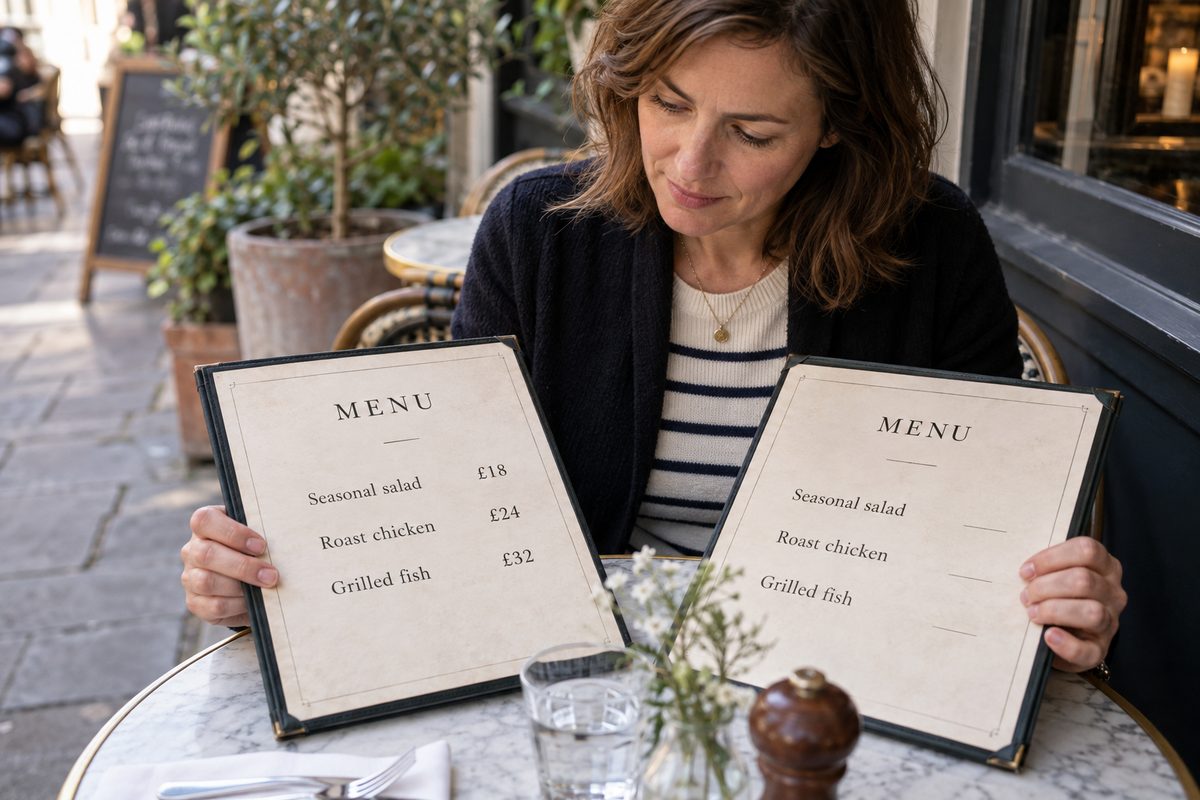
You're walking down a street looking for a restaurant. There are two places next to each other. One has the menu in the window with the prices on it. The other has a nice sign and a menu with no prices. Which one do you go in? Unless you're loaded or it's a special occasion, you go in the first one, because you know where you stand. The second one makes you feel like you'd have to ask, asking feels awkward, so you walk on. Nobody thinks the restaurant with prices in the window is cheapening itself. It's just being normal.
A coaching website works the same way. Your visitor is stood outside deciding whether to come in, and without a price you're making them ask before they even know if they can afford it.
If you show your price, what do you need next to it?
You need everything that answers "is it worth it for me?", because once the price is on the page, that's the question they're asking. It's no longer "what does it cost?" So the page has to answer it, right next to the number.
- What they get for it. How many sessions, how long, what happens in between, in plain words. A number on its own looks expensive. A number next to what's included looks like a deal.
- Proof right beside the price, not three pages away. A testimonial from someone like them, saying what changed for them. There's more on that in the testimonials post.
- A small next step. They've seen the price and they're still reading, so don't ask for a big commitment. A short call to check you're a good fit, or a first session they can book there and then.
- Who it isn't for. It saves both of you time.
And here's the bonus. The people who book a call already know the number. So the call is about whether you're right for each other, not a nervous build-up to the big reveal. That's a far easier conversation, for you and for them.
Where on the page should the price go?
Where they're deciding, which is next to what you offer and near the button that asks them to book. Not at the bottom of a page called "Investment" that nobody clicks on. If your homepage already says who it's for and what you fix, the price is the next thing they want to know, so put it where they'll look for it.
What if every client needs something different?
Then you don't show a price, and you explain why. I know this one from selling windows.
When I sold double glazing in the UK, the salesperson went to the house. People would say "just give me a price" or "just give me a rough estimate", and some window salespeople did exactly that. I didn't. I'd tell them we have different types of window in different designs. I need to measure up, find out what you need, go through the design with you, and then I'll have the price.
Coaching is much the same. You can't price a programme properly until you know what the person needs, and the price can change with a lot of things:
- how long each session is
- how often you meet
- how many sessions there are
- any supporting material
- any extra support between sessions
If you go this way, the page has to back it up. Tell them why there's no price, the way I said it on the doorstep: every programme is built around the person, and you'll have a price once you know what they need. Saying nothing at all just looks like you're hiding it. Show them what the price depends on, so they understand why you can't just give them a number. And lean harder on proof, because with no price to go on, your testimonials are doing all the work of convincing them the first call is worth their time.
Then think about the people who won't call. Plenty of people will never book a call just to find out a price. 94.3% of the coaching websites we looked at ask a stranger to book something, and for a lot of them that's the only option on the page. Offer something useful they can get with just an email address, so you can stay in touch with the ones who aren't ready yet. The lead magnet post has ideas for that.
Should you charge for the first call?
You can, if that call is real work. In the window trade, measuring up and going through the design was where the real job started, and in coaching the first call can be the same. If you're properly finding out what someone needs and building a programme around it, that's worth paying for, and saying so on the page tells people it's a proper session, not a sales pitch.
If your first call is just a quick chat to check you're a good fit, keep it free and keep it short. Either way, talk about money early on the call. Not at the end after forty minutes. Early, so neither of you wastes the time.
What should a coaching package include?
A coaching package should say exactly what someone gets, so they can compare it with what they're paying. That means the same things that change the price: how long each session is, how often you meet, how many sessions, what material comes with it, and what support they get between sessions.
If you've got two or three set ways of working, lay them out side by side on the page, with what's in each one and what it costs. Then people can pick the one that fits, instead of guessing. If every programme is built from scratch, show the menu of options instead, and give a price once you've talked. That's the window approach again.
And if you're not sure your offer is clear enough to put a price next to, that's a different problem, and it's the one the coaching offer post deals with.
Do "limited spots" and deadlines help you sell?
Hardly ever. "Only two spots left" and "the price goes up on Friday" are what's known as scarcity selling, and they get taught to coaches all the time, but the evidence doesn't back them up. We mapped 918 coaching markets from 2,004 books and 1,547 things real buyers wrote. Urgency helps the buying decision in 4.4% of them. Proof from other people helps in 92.9%.
So if you've been told to pressure people with deadlines while keeping the actual number hidden, you've been told to do the thing that helps least and skip the thing that helps a lot. I'd sooner see a clear price and a couple of real testimonials than a countdown timer any day. If you want to go further into this, how to sell coaching picks it up.
Questions coaches ask about this
Is "prices start from" enough?
Yes. It answers the question they're already asking themselves, which is "could I afford this?" You don't need to be exact, you just need to stop them guessing.
Should I put my prices on a separate pricing page?
Only if you put them where people are deciding as well. A pricing page on its own gets missed. Put at least a starting price next to what you offer and near the button that asks people to book.
What can I write if I don't want to show my prices?
Tell people why there isn't one, something like "every programme is built around the person, so I'll give you a price once we've talked." Then give them the shape of it: how long people usually work with you and how often you meet. That way they're not left guessing, and the ones who aren't ready for a call still know roughly where they'd stand.
The figures here come from our own corpus of 10,954 scored coaching websites and 918 mapped coaching markets. How we built and scored it.